What is your earliest memory of making something, and what does that memory reveal about who you were as a child? That feels a little like trying to remember the first time I ate food. I was making art obsessively from the moment I was able to clench a crayon in my teeny little fist. I was deciphering how cartoonists were using linework at the same time I was struggling to work out how to tie my shoes. I figured out core concepts like light and shadow and was incorporating them into crayon drawings years before I was ever introduced to any sort of “how to draw” books. I could see that the adults around me were impressed with the more realistic drawings and my desire to win their approval really fueled me to keep pushing my work in the direction of draftsmanship and craft. Those qualities are pretty near sacred in working class communities, so I dutifully built the foundation of my work on the advanced drawing fundamentals that were coming easy to me. I later came to understand that an aversion to that sort of rigidity was also in my nature, and a clashing between utilizing those honed skills while simultaneously disregarding and disrespecting them has turned into a real defining quality in my art.
When did you first realize that making art was more than an interest, that it was something you needed to do? Making art was never really a choice I made, and it never felt like something I was doing out of interest even. It was really just another bodily function for me. I did understand that being good at it gave me advantages in life, and a big one was that it provided a clear escape route from a life of heavy labor or other hard or even tragic outcomes common for kids that were coming up around me.
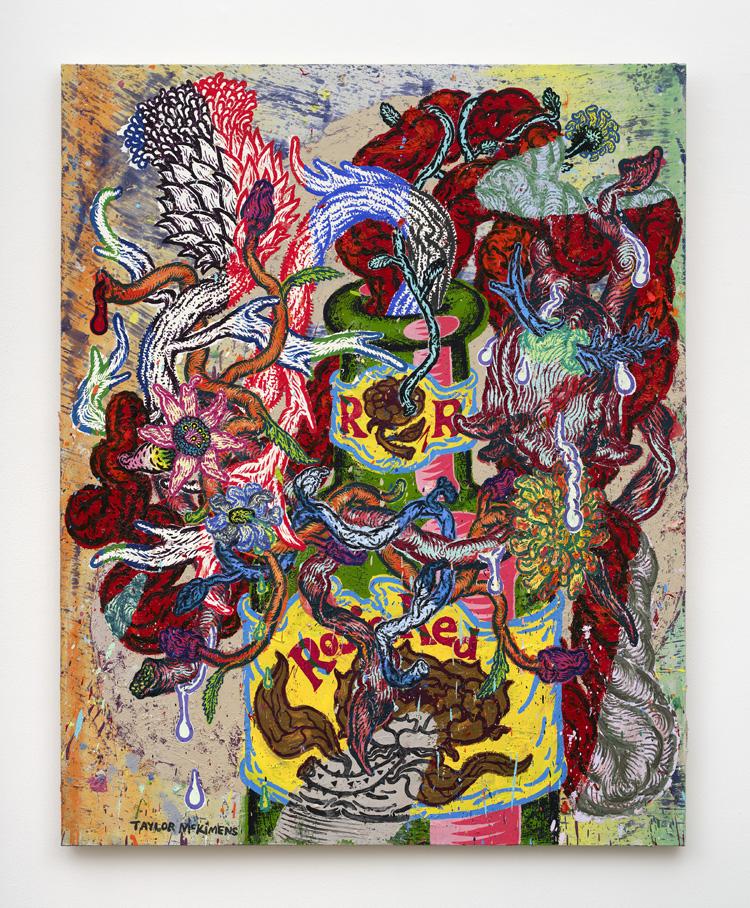
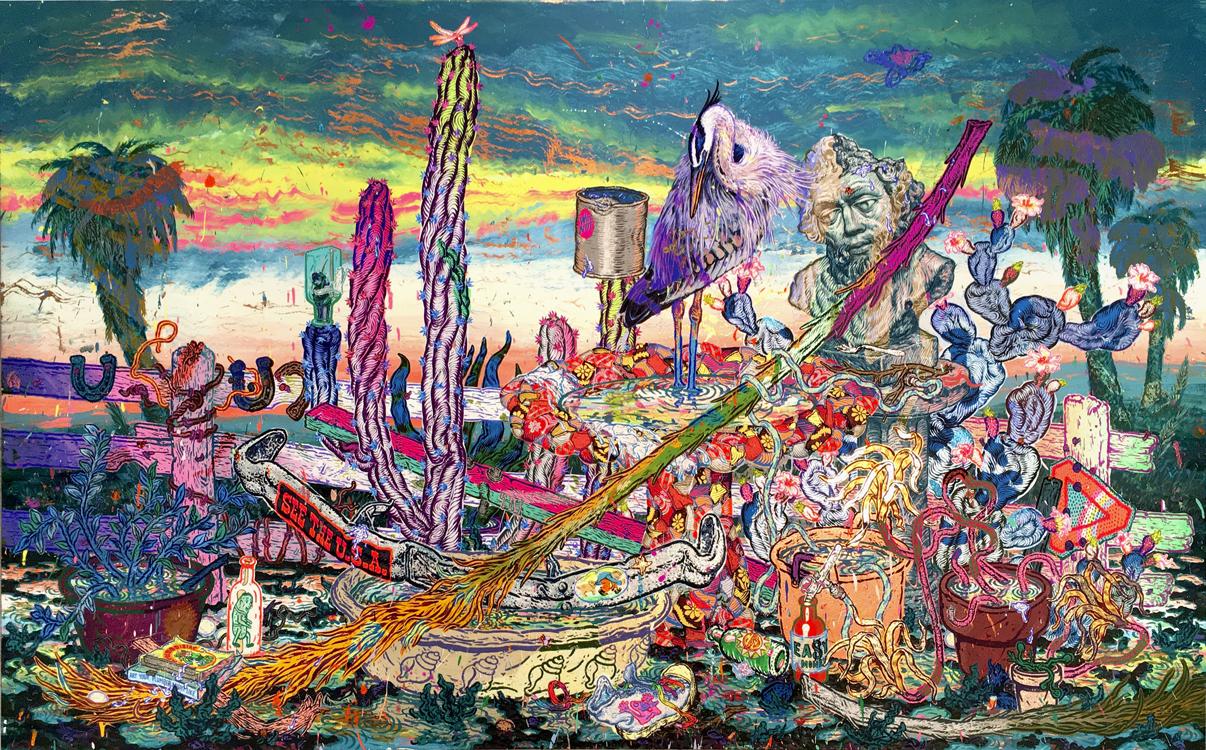
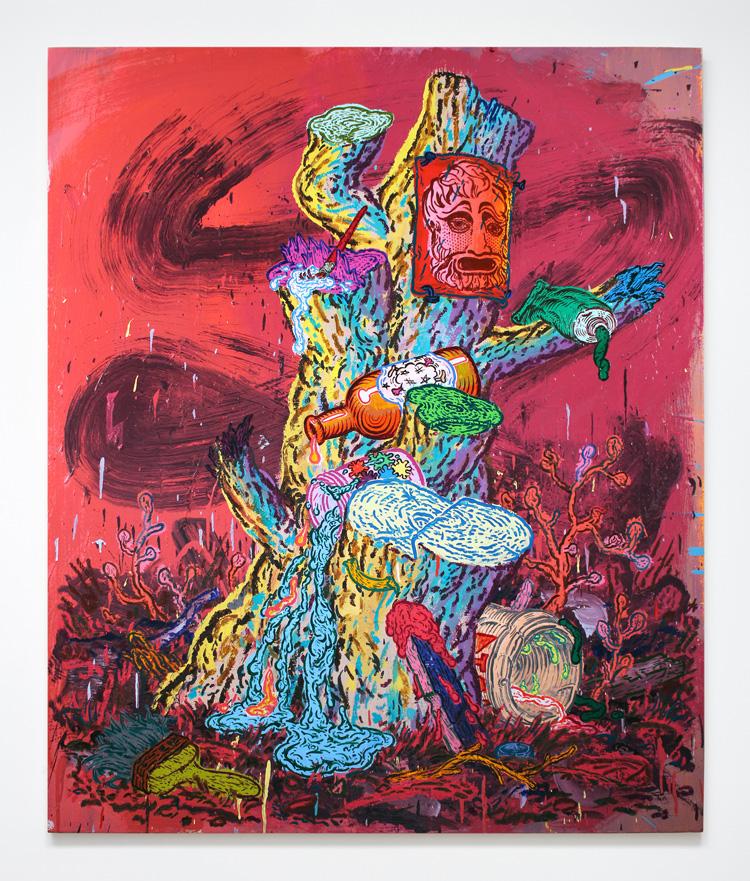
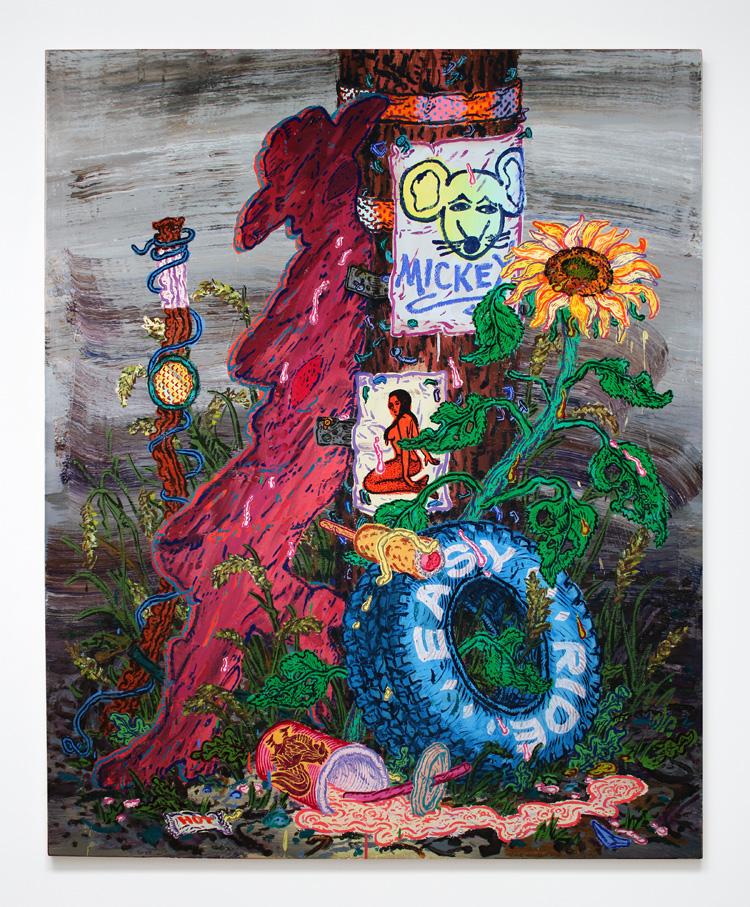
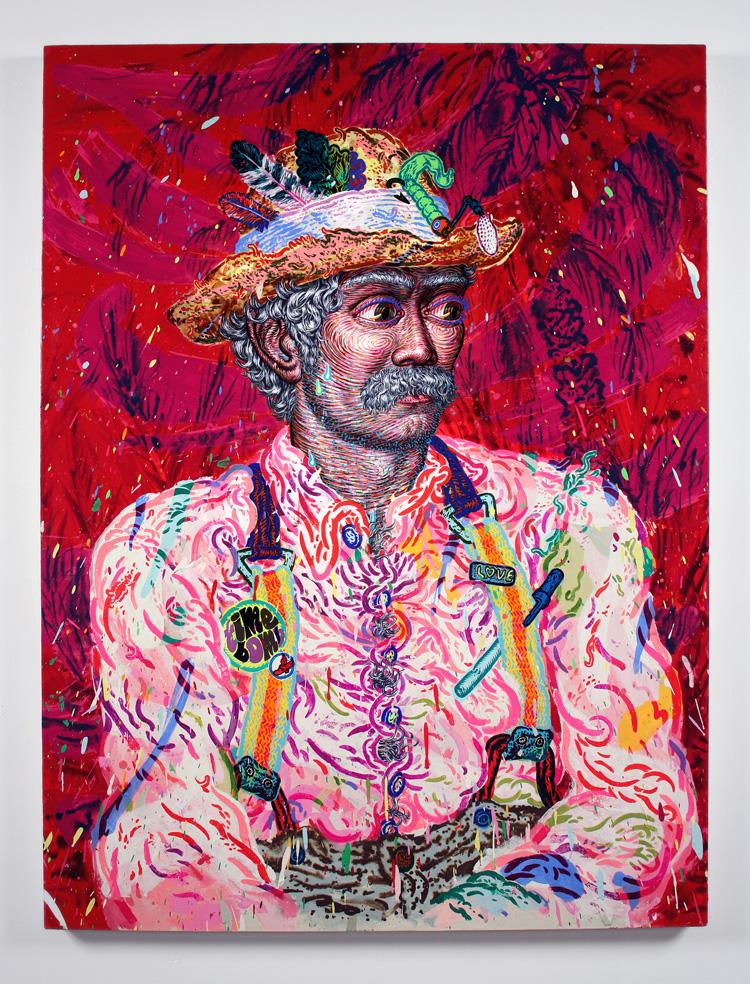
Growing up in California, what aspects of that environment still live inside your work today? The Imperial Valley is California technically, but it’s really a world of its own. It’s a small desert border town that is full of extreme contrast. Harsh and brutal temperatures melt and bake everything, and the sunsets can be especially psychedelic. Wind blows trash into all the brush and cactus, wraps it around barbed wire fences and packs it around junked out cars and trailers. Those visuals feel burned in and I still feel obsessed with drawing them. I learned to understand the power that exists in extreme polar opposites and the power that exists in the things that are generally deemed ugly and worthless. Even after years of living in NYC my work seems to focus on helping people everywhere take notice of how radiant and sophisticated their own trash can be.
How different is the person you are in the studio from the person people meet socially? My ADHD is pretty pronounced and in the studio sometimes it can really take hold of what I’m up to in there. Lots of walking around in a distracted fog. It's a real problem in a lot of ways, but when making art it’s a kind of superpower. I hyper-focus on the work and unfortunately can lose track of all else. It went undiagnosed for most of my life, which is a quintessentially American scenario for low-income folks riding out life like a bucking bronco rider without a healthcare plan. I’ve burned too many bridges and friendships before I finally got diagnosed and had any way to understand my constant time-blindness, and difficulty focusing aside from ill-timed super-human bursts of creative output. In person I feel like I come across fairly normal aside from interrupting people far too much. I definitely burn out on being social fairly quick though. Sometimes getting out of the studio feels like I’m out on work release and the euphoria of being out in the world does me a lot of good, resulting in me coming across as a much more grounded and collected person thankfully!
Are there aspects of yourself that only emerge through making art? If an artist is prioritizing making deeply honest art, and doing that well, deep truths about themselves should be constantly spilling out and becoming visible for themselves and others. The vulnerability in that exposure is the biggest part of what makes art gripping and infinitely relevant.
What role has love played in your creative development? Love is the whole deal for me. A lot of the art I make is about the love I have for overlooked and marginalized things and people. I empathize heavily with everything and everyone as crazy as it sounds. I’m able to feel a deep connection with people and really just everything, all of nature (or whatever this big churning soup we're all ingredients of is). It’s also a love for color and exposed vulnerability.
What emotional state produces your best work? I work my best when I feel content or at ease, when I feel a sense of peace. The trope of artists working best when they’re suffering is a sadistic falsehood. I could never understand why people are so obsessed with that idea. Tortured people are gonna still be tortured whether they can or can’t afford better art supplies and rent for an adequate space to live and work, believe me on that.
When you feel creatively blocked, what is usually happening beneath the surface emotionally? This is touching again on the previous question, but generally when worrying over basic logistics and money. Constant, endless stress over those things is a real heavy wet blanket on creativity. Artists are really going through it over that these days while rents are sky high anywhere that they would ever be able to get people to come see their work in person. I often hear artists from older generations marvel at how much less ambitious younger artists seem to be these days. They often don’t connect that comparison to the loft near a dynamic art scene they were able to live in for nothing while making such daring creative choices.
Do you think your work reveals things about you that you don't consciously know? Absolutely, that's definitely the whole point of making it. It’s a constant and repeated spilling of the beans. Searching for and revealing surprise truth is what keeps it exciting.
What did success mean to you when you started as an artist, and what does it mean now? I remember Donald Baechler asking me essentially the same question when I first met him. I had just cold-called him and he told me to stop by his studio. I assumed that question was probably just a filler question because I was pretty nervous and blanking out on things to talk about occasionally. I haven’t thought much about that question over the years but these days after moving back to LA from New York especially, it’s definitely become something I think about more. I’ve been wondering if Donald was in a place then that he was thinking about that question a lot, it seems maybe likely. I think I was just gliding along after being shot out of a cannon after art school and moving to NYC when it comes to that question. These days it feels more like something I’m thinking about more overtly but it still feels like a question that doesn’t really require an answer. The concept of success is really just a mirage that is always on a distant desert horizon somewhere anyway. We don’t ever actually arrive at it. Sooner or later our bodies stop being able to walk toward it and we end up like a cartoon skeleton in one of Gary Larson’s “lost in the desert” comics.
Are there themes that you return to repeatedly because you still haven't fully resolved them? I don't really aspire to resolving anything in my art. The whole process to me feels a lot more like traveling along and listening for cues as to which things to turn towards and which things to turn away from as I go. The idea of resolving anything along that path assumes a level of control that seems naive to believe anyone actually has. It feels a lot more like being on a path without a need to meddle with the environment as you go. The work itself is a kind of record of that internal expedition. It’s a kind of souvenir of the trip, or a slideshow of images to help others get a glimpse of what your experience might have been like on that ride.
What does a typical day in the studio look like for you? I wish I had something like a typical day. There’s not much of a routine. I tend to work in bursts nonstop until I run completely out of gas and then I sleep it off. It's a lifelong series of consecutive creative benders of varying lengths, spaced apart by intermittent windows of doing cleanup and catching up with all the other aspects of my life and studio logistics.
What part of making art do you find most difficult? Running a business that really makes zero sense as a business. Constantly making decisions that are objectively bad business decisions any way you look at them, in service of making objects that may or may not have a clear path to even paying for themselves. It’s a big mess of juggling and stressing in order to keep that needy art beast fed. I’m its loyal servant through thick and thin.
What part still excites you as much as it did when you were younger? When I’m in the zone and working, I really see no difference at all between making art now and when I was younger. It’s still the same level of excitement. Whenever it feels like it’s dissipating in any way, I’m just learning that I’ve turned in the wrong direction and I turn more until it begins to increase again. It’s really just a lifelong game of getting warm or getting cold until I’m back in the zone.
Do you think of your paintings as narratives, observations, or something else entirely? I’d say that between those two options they are most like observations, but how I describe observations really does actually feel like a highly personal narrative too.
What artists have had the most lasting impact on your thinking? Growing up, I was looking at comics in the newspaper a lot, and I think I learned a lot about how to form imagery from looking at Garfield. I think I started to first wrap my head around how to make paintings that felt connected to the way I was drawing from looking at garbage pail kids. I learned far more about mark-making from laborers applying drywall compound, stucco or paint than I have from artists making paintings. I understood sculpture best from kicking around on my carpenter parents’ construction sites and building chicken coops as a kid. Southern California custom car culture, which was really its own blue-collar, avant-garde art scene was formative. Its wild colors and sculptural innovation using language and approaches rooted in working-class life expanded my understanding of what might be possible in art. Abrasive and insubordinate imagery like Rat Fink that came from that scene by artists like Stanley Mouse and Ed Roth really affected me. I connected to the raw energetic imagery I was seeing in magazines, record stores and shows like Pee-Wee's Playhouse that I later understood was coming from Gary Panter or his creative seeds. Gary really represents a link between the art I knew in the Southern California desert and the art I came to know when refocusing on making work in more of a fine art context. His work is really at the absolute pinnacle in both areas. Seeing his paintings in person and ultimately getting to know him a bit really put things into a kind of context for me when it comes to understanding my own specific footing and direction in art. Donald Baechler ultimately became a real advocate of my work and a personal mentor. His trolling approach to incorporating marginal and pop imagery in a way that was both elegant and trashy really impacted how I see things, and in a way that feels honest and integral to me and my own work.
Was there a specific body of work that marked a turning point in your development? The most significant change that ever happened to me was when the concept of remaining true to my visual accent began to crystallize in my mind. Artists from disadvantaged or working-class backgrounds often are pressured to filter out formative creative influences they've acquired in those locations. They're taught to replace those influences with new ones that are more familiar or acceptable from the standpoint of established art world visual approaches. Once this concept occurred to me, it became easy to begin removing anything that I overtly tried to become influenced by that wasn't directly specific to my own honest, personal experience or my nature.
What risks have been most important to your growth as an artist? The biggest risk by far was choosing to do it at all without any kind of financial safety net. That’s a huge one that is not very sexy to talk about, but lack of support during low times and hard spots really snuffs out a lot of great artists.
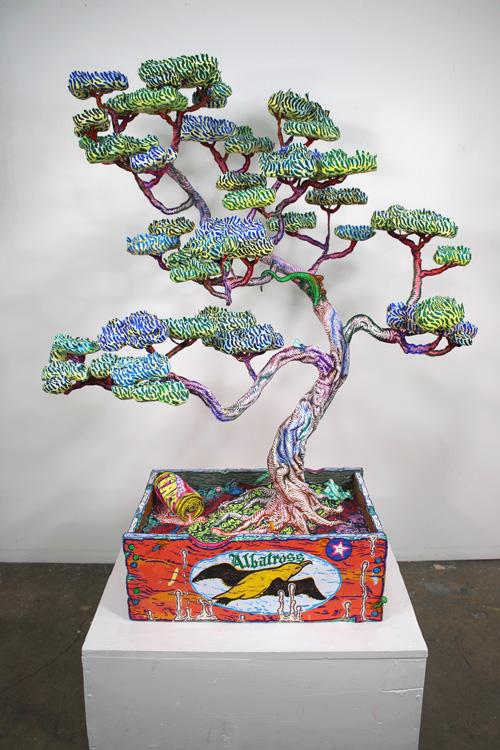
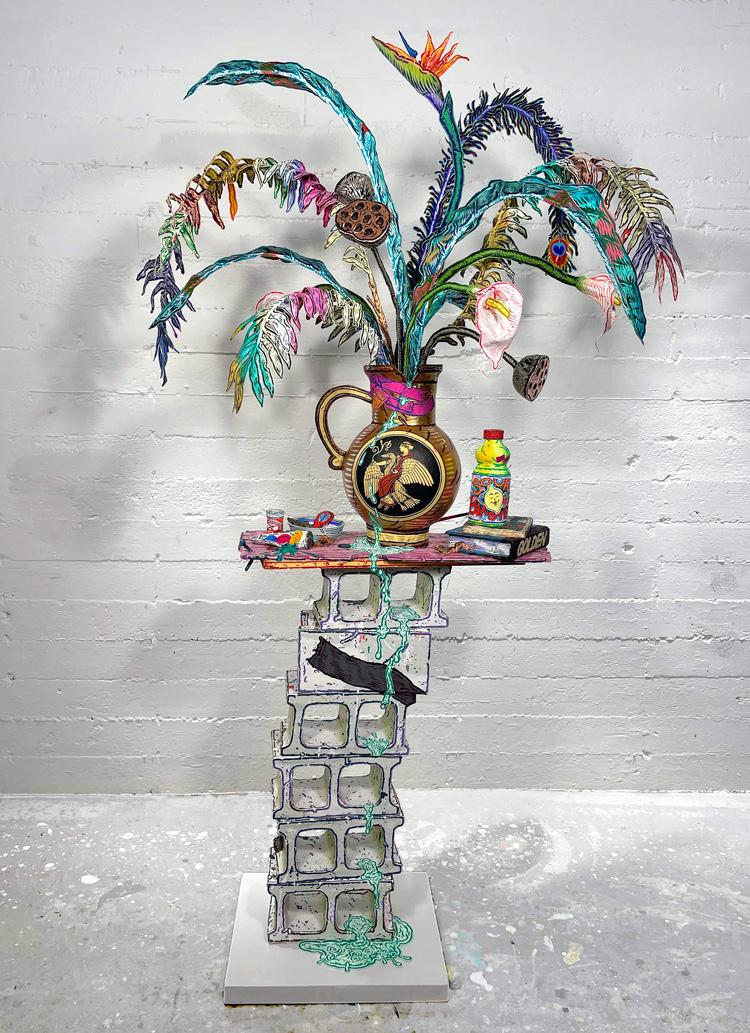
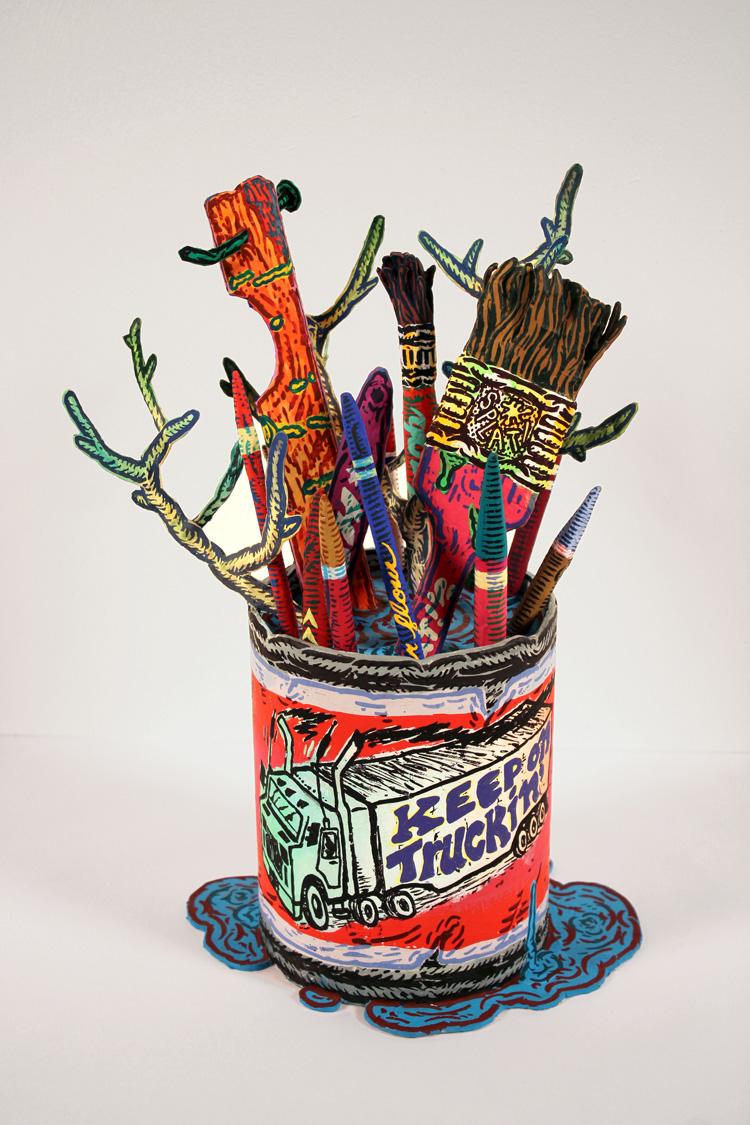
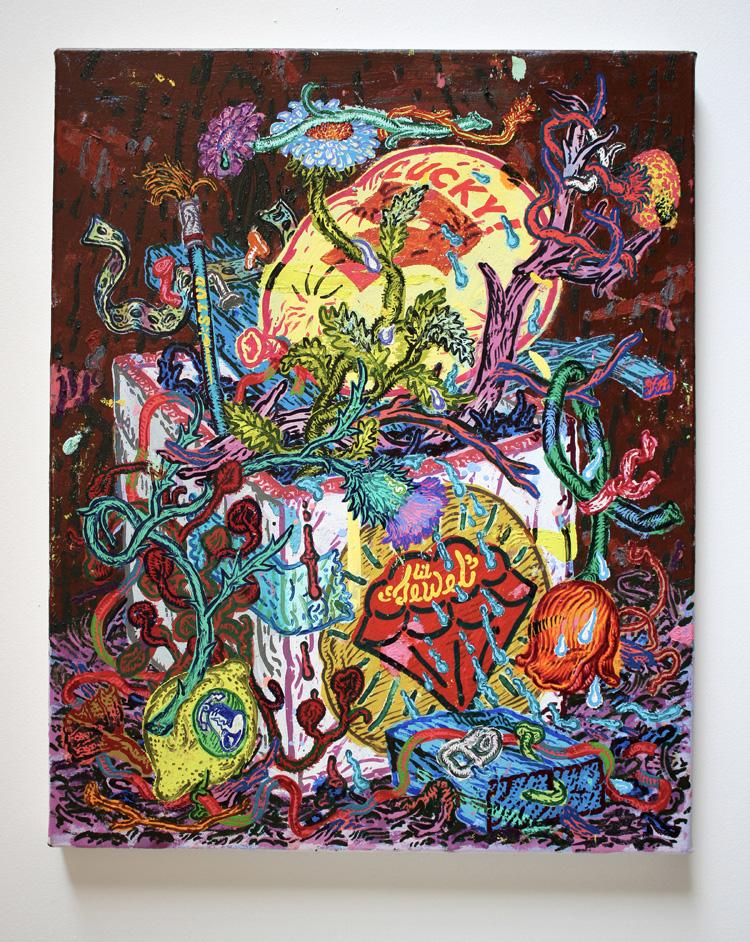
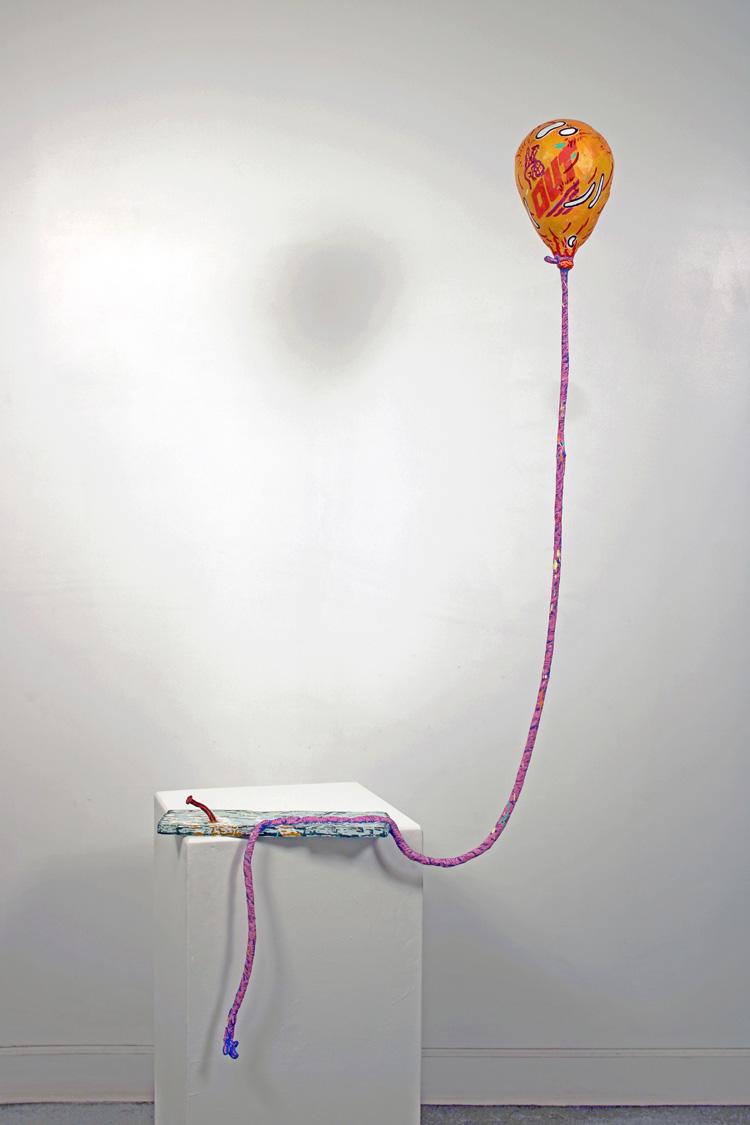
Are there techniques you've developed that feel uniquely your own? A merging of drawing and sculpture has happened in my work over time. And there doesn't seem to be anyone else that's doing anything like it. Red Grooms is probably the best known artist for merging drawing with sculpture, but he has a very slap-dash and un-nuanced approach. I could never make peace with how they always somehow felt like novelty corporate stock illustration dioramas though. Lynn Foulkes on the other hand was really incredible at making a nuanced blend of painting and sculpture that never felt anything like a gimmick. I’ve never had any interest or aspiration in the concept of merging drawing and sculpture, or mixing two and three dimensional work. That all just kind of happened on its own. It really was a direct result of my decision not to follow the path of becoming an illustrator, which was always just sort of predetermined since I didn’t know art was ever even an option. When I thought about what doors that direction shift could open up in my work, I realized that drawings didn't need to be conveniently sized anymore. Drawings didn't even need backgrounds, so I would just cut them out and then my studio space instantly became the drawings’ backgrounds. Ultimately, I began building hidden structural supports for them, and they evolved into drawings that exist on their own, freestanding in actual space. The drawings continued to split and change planes with increasing complexity over time, ultimately becoming drawings with no primary intended point of view. The drawings would change compositions as you walk around them and would occupy physical space much in the same way that the actual subject the drawing is of, would occupy that same space if it were there. The sculptural work feeds back into my paintings also in multiple ways, and they often actually end up looking like paintings of three dimensional drawings. These were never things that I conceived of and then executed. They’ve all been a natural gradual evolution born out of my own life experience and the effect it’s had on my work over time.
How conscious are you of the viewer while making a piece? The viewer is important to me but while I’m actually making the piece I’m hardly even conscious of my own self. I generally have blinders on to everything other than the work in front of me.
Has success changed the way you approach the studio? Success definitely doesn't feel like the right word but I've been very fortunate to have been able to make a living from my art for so many years. I'm really grateful for the support I've received from people who have felt connected to or moved by what I’ve been making enough to want to make it part of their lives. I’m not sure if that affects my approach to the studio though. I feel driven now when it comes to new ideas I’m excited about much in the same way I was when just starting out and completely unknown for what I’ve been making.
How do you navigate the tension between personal expression and professional expectations? If those two things ever feel like they are at war, I will always fight for the defense of personal expression and making sure the art is the best it can be. Without that part the professional expectations are nullified anyway. Pray for peace!
What responsibilities, if any, do artists have to their audience? I don’t think they really do have any responsibilities. That comes down to each artist’s nature. It’s in my nature to want to connect with people though so for me it is important to consider the audience. I want people to receive what I’m saying. Constantly I’m noticing things that are exciting and fascinating to me and I want to point them out to others. I love walking down the street with someone and pointing out the little things that I’m noticing that they are often overlooking. I love walking and quietly noticing alone as well, but sharing and connecting with people is so much better. The things that are being overlooked get to have a fleeting moment in the spotlight and the person seeing it for the first time gets a good laugh or even a deep revelation. It’s rewarding to me to see them realizing there is magic happening around them at all times.
What is the most important lesson you've learned from a lifetime of making art? Accepting that I have no control or even influence over things has been a major lesson for me. Artists often are delusional about how much influence they wield on things around them. Some artists are doing the exact right thing at the right time and in the right place to become deeply influential, but it is extremely rare. I’m into the idea of going to wherever feels like the right place, but time is a little out of our hands. Doing the right thing is something that is extremely tricky. I believe that choosing what to do for an artist is about deep honesty, and choosing what to do based on speculations about achieving influence is needy and will poison the work.
If someone wanted to understand you through a single artwork, which piece would you choose and why? For me it’s always just the newest one. I’m constantly pushing to evolve and grow with each thing I make and the newest one is always most aligned with the current version of myself. Part of what gives direction to how I change my approach on each next artwork is a kind of overly critical view of the last one. I sort of gotta jam that one down with my boot so I can make it another step up the hill.