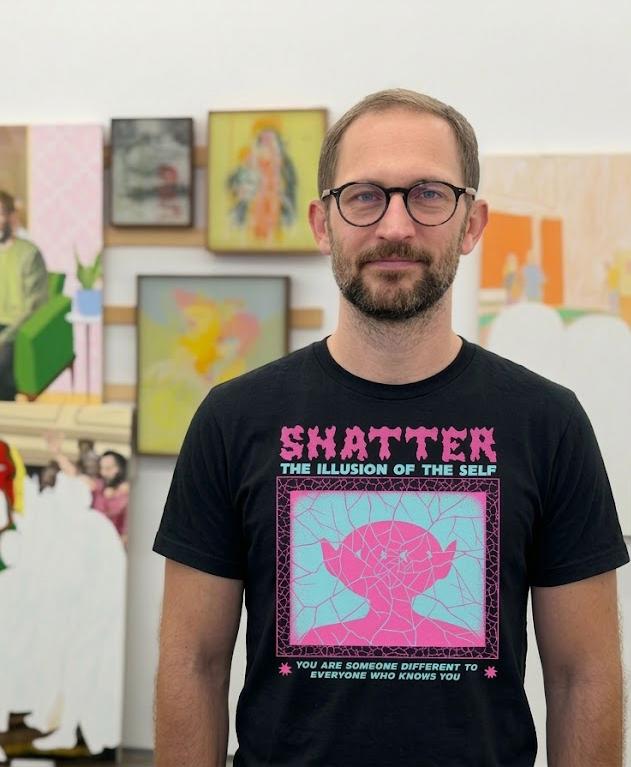
One word to describe Jeremy Uglow? Existential-Constructivist.
If your paintings could talk, what do you think they'd say about you? Hopefully they would talk about themselves and leave me out of the discussion.
What's something your collectors would be surprised to learn about your studio habits? I am an exceptionally clean painter. I like to say that I could paint for a full eight-hour day in a tuxedo, then attend a formal event without a drop of paint on me. Also, I clean all of my tools to mimic the day they were purchased.
If one of your paintings became the set of a film, what genre would it be? Present-day historical pseudo-non-fiction.
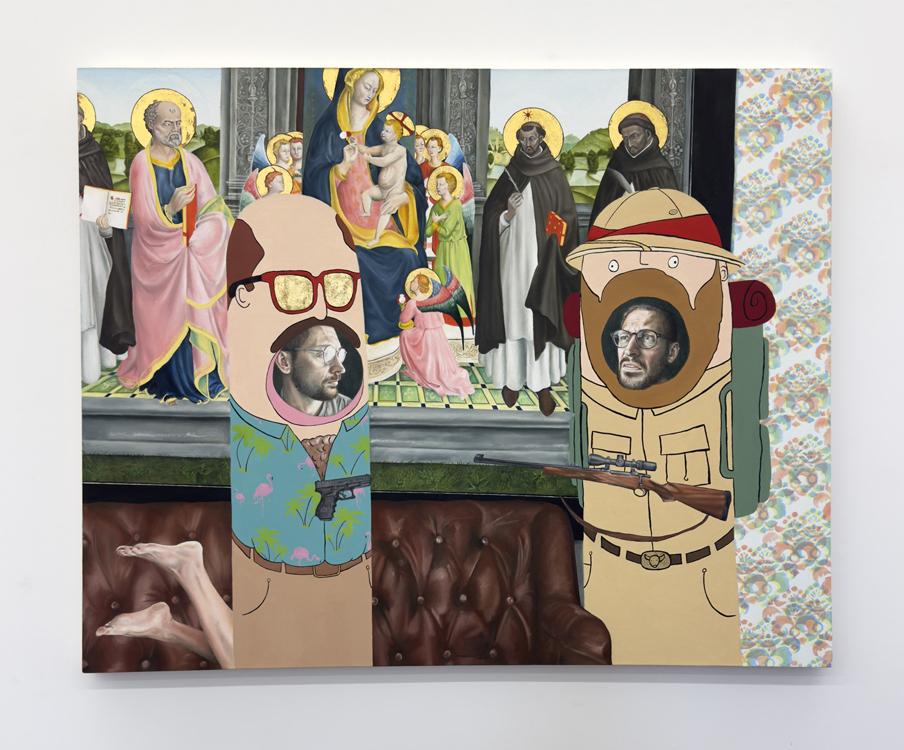
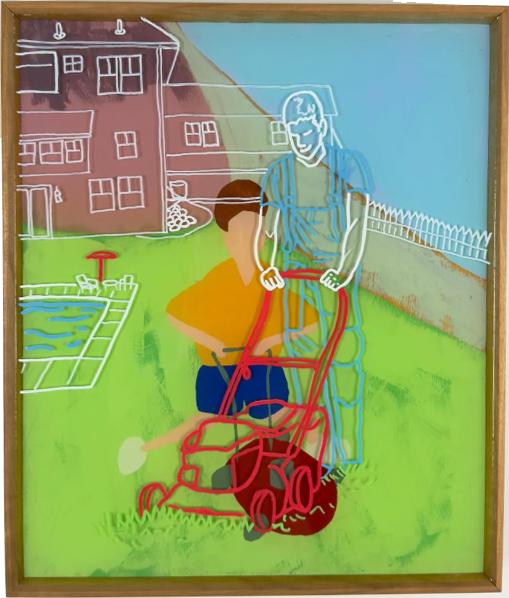
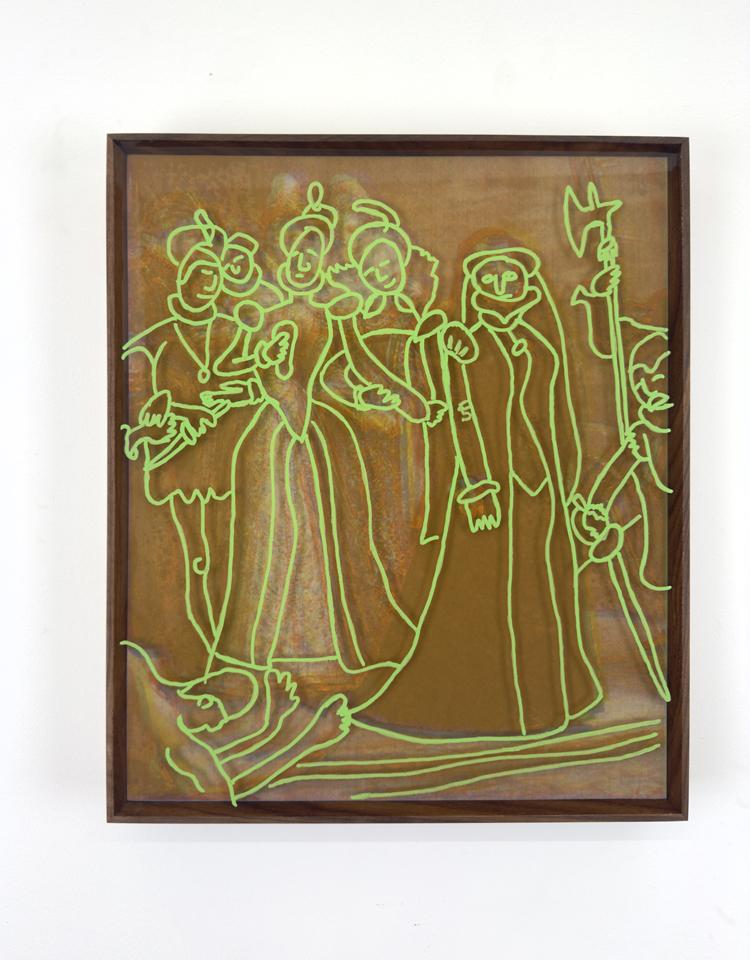
Your paintings are a pure combination of traditional and surrealism. Was this intentional or an accident? My paintings are entirely intentional. There are, of course, readings that I may not have intended, but every element in each painting has been chosen to fill a symbolic role. I utilize multiple styles to speak through the various modes of visual language that we have at our disposal and not limit myself when we have millennia of information that informs our world.
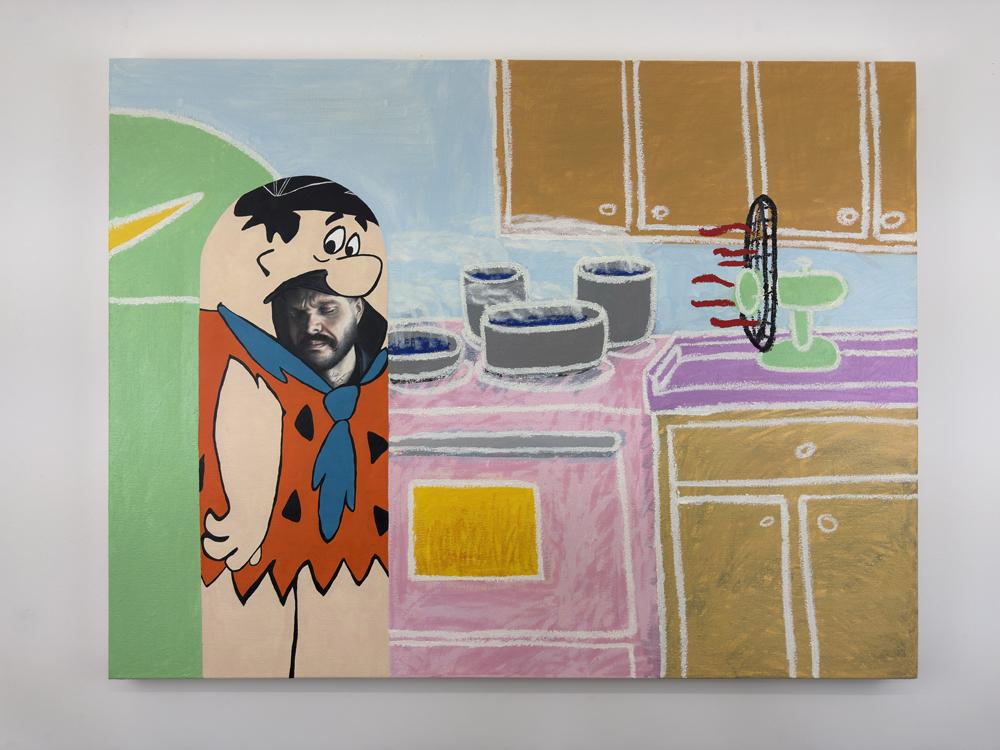
You incorporate your friends' faces with cartoonish bodies in your paintings. Is this a homage, or is there an underlying reason? The cartoonish bodies are what I call my "god costumes"—god in the sense of idealism or the idyllic form a person could become. They are designed to contrast with the painted environment, illustrating a separation between layers of the painting's realities. The costumes take the form of a two-dimensional children's blow-up punching bag that contains a "hole" through which a realistic portrait looks out. In essence, the costume and the entire painted scene act as a framing device for the figure as the royal "I," "you," or "they." It is simultaneously created by and created for the face looking from the darkness. It is the "peek-a-boo" board one might find themselves excitedly—or forced—to have their photograph taken within. Ultimately, the cartoon is the costume that we all wear in our public and private lives, surrounded by elements and ideas that helped to shape it.
What would your twelve-year-old self think of the work you're making today? I think that my younger self would be into my current work. I had just, the year before, realized that I could shade with graphite to make (relatively speaking) illusionistic forms, so I think I would be pretty excited for my future.
If you could borrow one artist's studio for a single day—past or present—whose would it be, and what would you do first? Maybe Thomas Kinkade's studio just as he was about to make his name... so I could destroy everything in his space. Only sort of joking. I would love to see the inner workings of Rogier van der Weyden's and Jan van Eyck's studios and how they managed to capture such magnificent detail through the difficulties of their time... or to be in the Swiss café, Cabaret Voltaire, where Dada began... or to be present to witness the power that Diego Velázquez held over King Philip IV of Spain. All in all, one day wouldn't be enough time for me to create anything worthwhile, though each would be fascinating to experience from a firsthand perspective.
What's the strangest place where inspiration has unexpectedly found you? I don't know that it's a strange place, but... time spent on airplanes usually gives me a still moment to read and reflect. I most enjoy sitting in a dive bar with decent music and just enough noise to become a sort of static. I get my best concentration in that setting.
Which painting of yours changed you the most as an artist? "Three and One Chair" from grad school was definitely a landmark for me. Before this painting, I was working on a series of life-size portraits that I was attempting to imbue with more intention than I was actually depicting, so they were inaccessible to the viewer. Near the end of my first year, I had a critique with my faculty critic, Kate Moran, where we were talking about an idea for my next painting that was to be figureless... She told me that she wanted to see the painting larger in order to allow it to truly breathe. I was apprehensive to simply go bigger for the sake of it, but I sat with that critique and had many realizations that forever altered my perspective.
Is there a recurring shape, color, or motif that keeps following you without invitation? No, everything manifests in my work because I have a use for its presence.
If your work had a soundtrack, what would be playing in the background? When I paint, the music I normally listen to is metal, with bands like Bongripper, Dödsrit, Thou, Yob, Supercontinent, or Lightning Bolt. Metal allows me to have a certain noise to keep me focused but still gives me the mental space to think over the sound. Certain bands, like the ones I mentioned, give me such positive energy that it helps me transcend into a near-entirely liminal space, shutting out outside noise to concentrate on what I am making. I also listen quite frequently to a couple of podcasts: Hello from the Magic Tavern and The Partially Examined Life. Each podcast fulfills a very different desire but can be equally helpful in my process.
Coffee, tea, silence, music, or complete chaos—which produces your best work? I enjoy the energy of coffee to start my day, but never chaos. I enjoy changing environments and being in a state of flux, but when I am working, I need some level of certainty that I will have the time and space to work until I have finished for the day naturally. See the previous question for the sounds I enjoy while working.
What's one artistic rule you've happily ignored? I was told in college that I shouldn't mix styles in a painting... I never thought that made much sense. We live in a multi-pluralistic environment with so many possibilities that it would be a disservice to ignore the potential of juxtaposing different visual languages to portray a given intention. I hold true that, so long as we don't invent our own language in its entirety, we can communicate through an innumerable vocabulary of historical information, framing it into a context that suits our intended message or conversation.
If someone could step inside one of your paintings for five minutes, what would you hope they notice first? That everyone exists in a world of their own perceptual creation and that we are different to everyone we meet because of that very idea.
Which emotion is the most difficult for you to paint? All of them. When I make a painting, I shape the emotion or intended conversation through layers of contextual clues so that the image can be more nuanced and require a slower read. Being too forthright can lead to feeling didactic or overly simple.
If you weren't an artist, what profession would satisfy your curiosity? I enjoy the natural sciences and philosophy... though I'm not sure what profession exactly.
What's a question you're surprised people never ask you? Can I buy this? When can I give you a solo show in a museum?
If your next exhibition had to include one completely unexpected element—no painting allowed—what would you add? I won't be tricked into giving away my secrets.