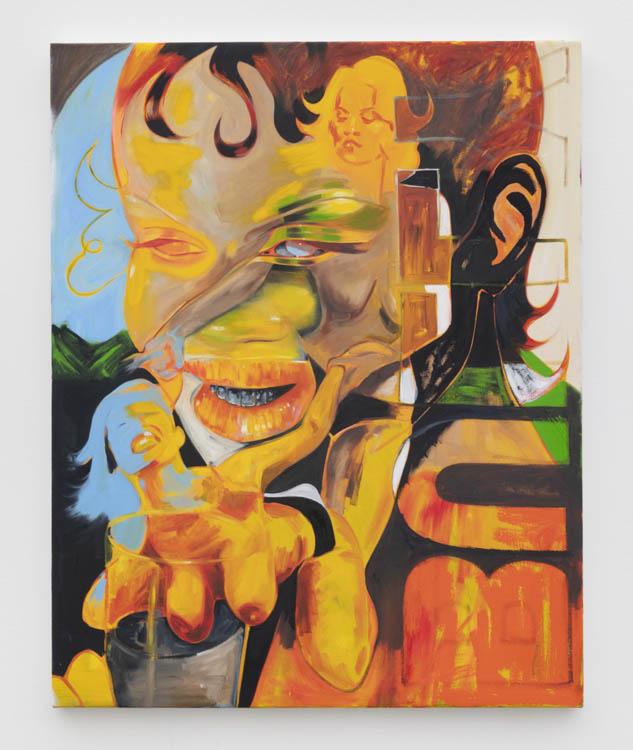
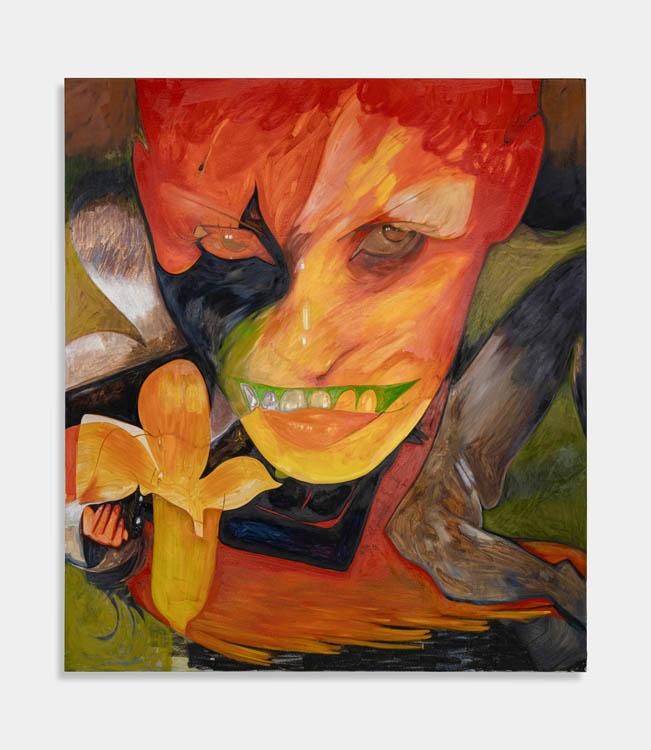
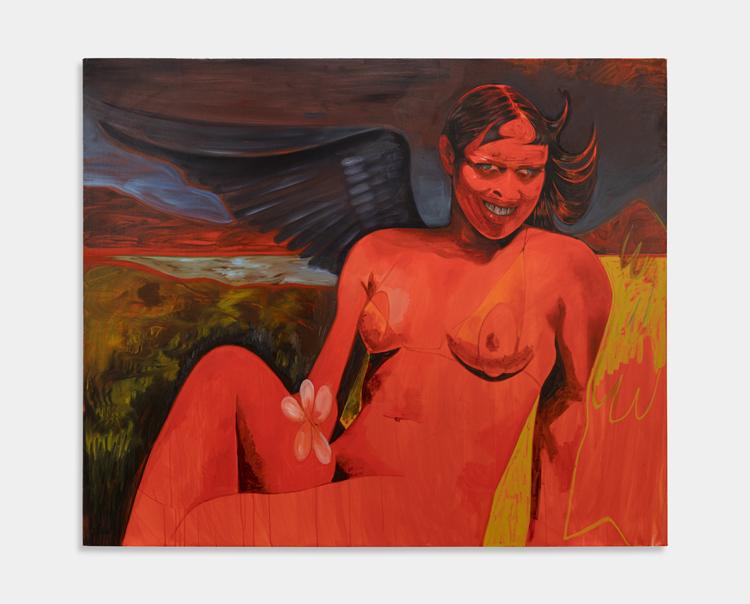
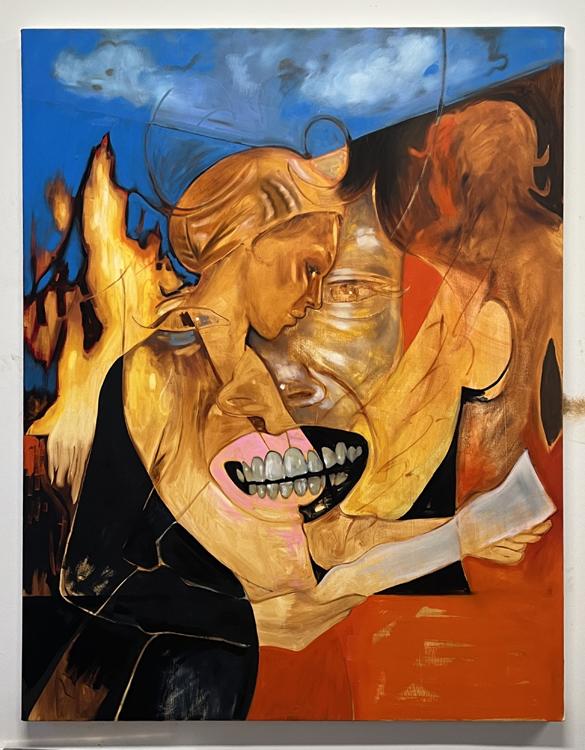
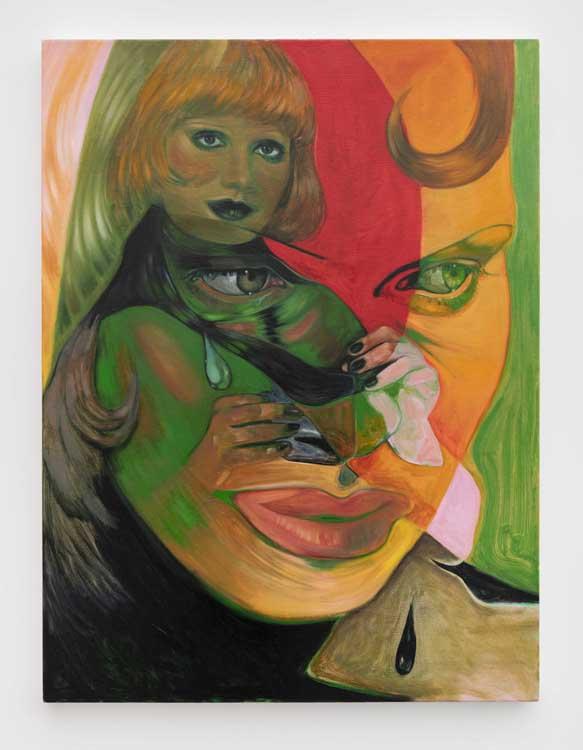
Where were you born, and where do you currently create?
I was born in Boston, Massachusetts, and I currently create in Queens, New York.
What was your first experience with art as a child?
This wasn’t my very first experience with art, but I have a vivid memory of going through a phase where I drew people vomiting with their hair flying back, or shitting their pants specifically, pants splitting open from the event. It would be entire families vomiting and shitting themselves. I remember really enjoying drawing that kind of thing in the way children hyper-fixate on something. I was completely committed to it for a brief period. I’m not sure why I grew out of it. The hair flying back was a nice touch, though it implied force.
Did you have formal training in art, or was it something inherent?
I have training, I guess, although I didn’t receive much formal training in painting. I studied printmaking. Sometimes I try to teach myself traditional painting techniques, and then it starts to stress me out. I feel like I know enough and also nothing at all, in a way that allows me to grasp at straws and sometimes yield interesting results.
Your paintings often feel suspended between dream and memory. Is this intentional?
That’s where they come from. I spend a lot of time in my head. I think painting is a way for me to communicate a great deal without feeling overexposed.
There’s a tension between intimacy and distance in your work. Is that something you consciously build into your paintings?
I think so. I’m interested in fantasy and the maintenance of it, revealing a lot but nothing at the same time. Complete transparency forecloses fantasy. What keeps the imaginative machinery running is the gap between what is known and what remains withheld or ambiguous. I’m drawn to partial opacity.
Your paintings carry a strong emotional intensity. Do you see painting as a form of self-examination?
A lot of the work feels like a conversation I’m having either with myself or with specific people. I can put a lot of what I want to say into a painting, and it feels like a form of cathexis. I’ve charged an object with my interiority. I’ve made an object that is essentially Morse code. It’s not meant to be fully understood. It’s a challenge, a threat, or a projection. If you think a painting is about you, you win a prize.
Your use of color feels psychological rather than descriptive. How do you know when a painting has found its emotional balance?
I think I just know. If it starts to feel sentimental, I hate that. Ideally, I’m trying to arrive at something that is difficult to name.
Do you think of your paintings as narratives, fragments, or something more open-ended?
Sometimes they’re fragments, like catching something mid-thought. Sometimes they are open-ended questions or observations I have.
How important is ambiguity in your work?
It’s a major part of the work. I’m a fluctuation, and the work reflects that. If everything is legible, there’s nothing left to do.
How has your approach to painting changed over the last few years?
I think I’m just trying to abuse myself the least right now.
Which artists, writers, films, or musicians have been shaping your thinking lately?
I’ve been watching a lot of Robert Altman films recently. My favorite right now is That Cold Day in the Park. It’s very bizarre and off-putting, but Altman is brilliant at allowing humor to sit right next to something disturbing. I also listen to a lot of DJ sets on SoundCloud while I paint. I really like MIRA MIRA right now, really good stuff. Brilliant stuff.
What conversations do you hope viewers have with themselves while standing in front of your work?
I want people to become comfortable with not understanding everything all the time.
If you could have dinner with three artists, living or dead, who would be at your table?
Rainer Werner Fassbinder, Juanita McNeely, and Cookie Mueller.
Name three things you can’t live without in your studio.
Nitrile gloves, thinner, and airflow.